Marginal Notes 17: Unsung heroes

There have been many books written about the role of men and women during the two world wars and the many other wars that have, sadly, followed. For all these gallant people, there are thousands of other ‘ordinary people’ whose war experiences have not been chronicled.
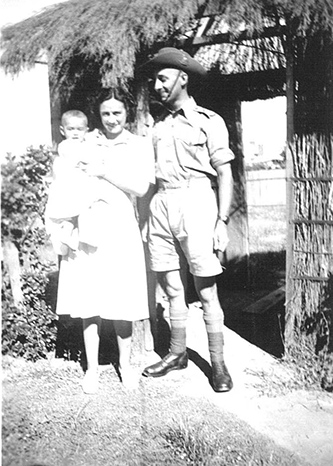
Two such men are my father, Leslie Craddock, and my husband’s father, Thomas Burdon.
After marrying in 1939, my parents, Les and Muriel Craddock, had not quite three years together, and less than a year with their daughter, Patricia, before the Japanese attacked Pearl Harbour and Les volunteered for Army service. He enlisted at Kilkenny in Adelaide. The war took him to northern Australia and south-east Asia. For most of the Pacific War he worked in an ordnance section supplying parts for army vehicles.
Opportunities for home leave were few, and Les soon regretted the isolation from his new family. His wartime diaries are sensitive and articulate:
‘1 August 1942. The first of August already! Hell, where is the time going? Over 7 months since I first put on Khaki, 7 months which in one way seems no time and in another seems like 7 years. I wonder how many more must pass before I can leave this life behind me again.’
In October 1942, Les had his first direct experience of Japanese bombing. Many of the American soldiers he met were convinced the war would end within the year. They were wrong.
Jonathan’s father, Thomas Wilkinson Burdon, joined the British Army in 1939 at the outbreak of World War II having just completed a Degree in Zoology at the University of Durham. Tom served in the Army for several months and then volunteered for an unknown assignment but, as he told Jonathan in later years, the offer stated “must be interested in police work”. Tom was then discharged from the army and joined the police in northern England as a clerical worker. He was subsequently sent to India where he undertook three months training, becoming a Superintendent of Police at about the age of 22 years. He went home to England on leave at Christmas time in 1944, during which time he met Barbara Hobson. Two weeks later they were married, such was wartime Britain. Tom then had to return to India and Barbara didn’t see him for nine months whilst waiting for a passage to India. Following partition of India in Pakistan in August 1947, Jonathan’s parents returned to England and his father took up employment as a scientist.