Marginal Notes 37: Remembering Margaret Woodhouse

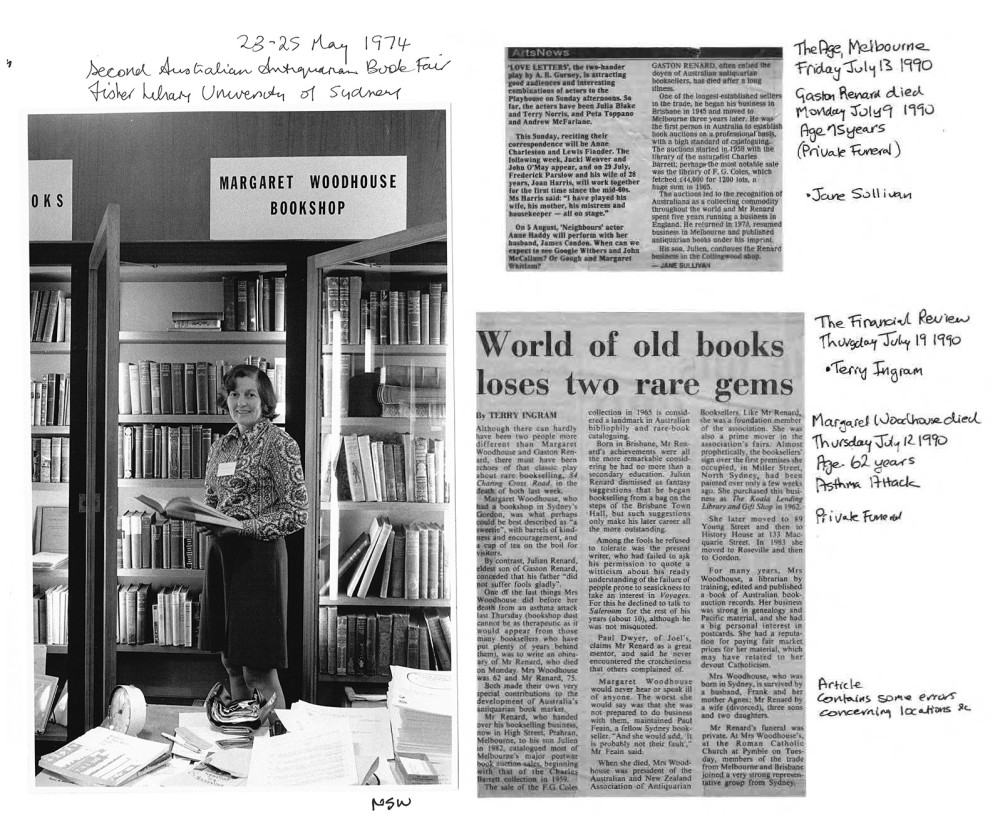
"On 9 July 1990 Gaston Renard passed away at the age of 75. Three days later, following an asthma attack, Margaret Woodhouse died at her home in Gordon on Sydney’s North Shore. Margaret had become president of ANZAAB in 1989. One of her last actions as president was to write an obituary for Renard. Every member of Australia’s book trade felt these losses keenly, none more so than Kay and Muriel. With these two deaths, the Craddocks lost two close friends and two important mentors."
This extract from Stuart Kells book “Rare. A life among antiquarian books” (Folio, Sydney, 2011), reflects the influence of two booksellers in my life. In particular, Margaret was not only a role model, but also a dear friend with whom we corresponded on a regular basis, sharing trade information (and gossip). Some of my lasting and vivid memories from the past sixty years are of the interaction my mother and I had with Margaret. However, it was in fact my father, Les, who first became friendly with her during his interstate business trips.
In Sydney he visited bookshops, developing a friendship with the diminutive bookseller Margaret Woodhouse. Margaret had trained as a librarian and possessed a wonderfully constructive and pleasant manner. In 1962, she purchased a small shop in Miller Street, North Sydney. She turned the Koala Lending Library and Gift Shop into an upmarket bookshop and became a first-rate bookseller, with a specialty in rare Australiana. Apart from Les Craddock, her early customers included the great Australian bookmen Sir John Ferguson, Geoffrey Ingleton and Walter Stone. . . .
On a trip to Melbourne, Margaret Woodhouse came to Locke Street to appraise some Australian detective stories and true-crime pulp magazines that Muriel has purchased from Kirk’s [Bazaar]. Muriel brought out two string-tied bundles and Margaret, without inspecting them, nominated a sum. Muriel said ‘I couldn’t possibly take that much’, but Margaret stood firm, with a bundle in each hand, arguing she would only take them if she could pay the price she offered, to refuse her was impossible, this stand-off was the genesis of a long friendship between Muriel and Margaret.
In 1971 Muriel told Margaret that she was thinking about her first international buying trip—to the south island of New Zealand. Margaret responded ‘if you are going to NZ I would consider coming with you, as long as I wouldn’t have to look at caves and hot-springs’. The trip was successful both personally and professionally:
Margaret laid claim to all the Australiana, while Muriel was free to do as she liked with children’s books and other general antiquarian fare. The travellers hired a car in Christchurch. Margaret had never learned to reverse, and Muriel never learned to drive at all. Whenever they stopped at a shop or at their nightly accommodation, they had to go inside and ask someone to park the car.
A year later, when I was planning my first international buying trip—this time to England— Margaret gave me lessons on how to board an airplane carrying heavy bags of books which appeared to be light. Despite her diminutive size, she was much better at this than I ever was. She also advised me to ignore casual invitations from men to ‘see the town’, which she was sure did not mean that.
Margaret’s influence on my career was not only as a bookseller who championed fair-buying but also as a sponsor (along with Gaston Renard) for my application to become a member of the Antiquarian Booksellers’ Association (International), which was accepted in 1972.
Margaret Woodhouse was a founding member of ANZAAB, becoming the Association’s fourth president in 1989. She was one of Australia’s most respected booksellers.