Marginal Notes 46: Signed and association copies

Signed copy: . . . just bearing the author’s signature – and could often be the result of a promotional book signing session.
Association copy: . . . a book which once belonged to, or was annotated by, the author; which once belonged to someone connected with the author or to someone of interest in his own right; or which belonged to someone peculiarly associated with its contents.
Limited Signed Editions: . . . issued by the publishers in a specified number of copies signed by the author. Desirable, but not classed as signed or association copies.
[Carter, ABC for Book Collectors].
For many book lovers, there is a sense of excitement, thrill or reverence in holding a book that has also been held by a famous, or favourite, author or person of importance. Sometimes it can be an association with someone who is only important to oneself for a variety of reasons. During my more than sixty years as a bookseller I have had many thrills and excitement when holding and cataloguing books either signed, inscribed by or owned by authors, illustrators, printers, politicians, kings and queens, and makers of history both famous and infamous, or with a provenance of importance only to me.
Some authors, such as Nobel Prize winner Patrick White, rarely sign or inscribe copies of their books and consequently such copies are extremely rare. In contrast, Australian writer Frank Clune signed an enormous number of his books, and most copies bearing his signature or inscription do not have significant added value. Indeed, it is a ‘trade joke’ to describe unsigned copies of Clune’s books as ‘the rare unsigned copy’.
Many years ago, we had a copy of A. J. A. Symonds’ biography of Shelley, which bore the signature of Oscar Wilde. It was an unprepossessing copy of an 1879 reprint in Macmillan’s English Men of Letters series. Without Wilde’s signature it was worthless, but the presence of the early, very simple, signature of Wilde made it extremely rare and valuable. Apart from the signature the book had several passages scored in the margins in pencil covering subjects which are likely to have been of interest to the young Wilde, such as Shelley's ‘daring’ and ‘lawless’ occupations, the youth of great artists, and even his ‘passionate attachment’ to a schoolfellow.
We had the distinct pleasure of handling this copy twice, having bought it back from the family of our original purchaser after her death. It was then sold to a father as a 21st birthday gift for his daughter.
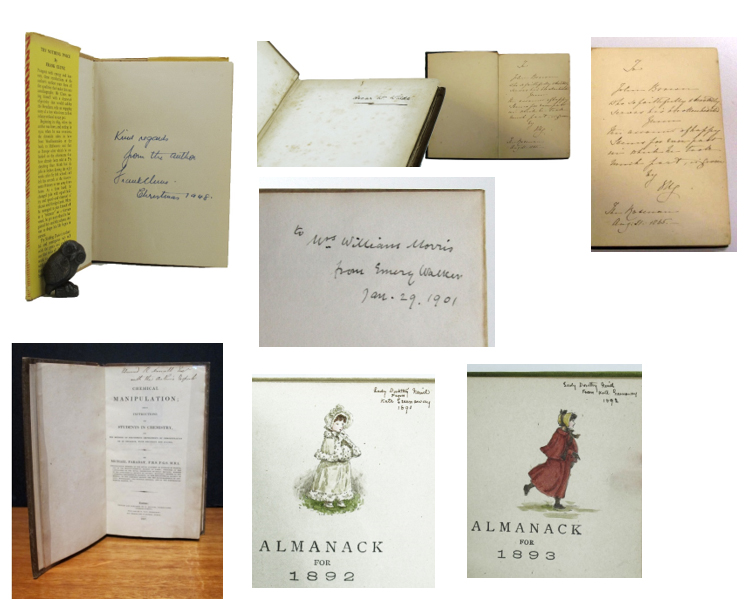
Another memorable association copy was the first book issued by the Doves Press – an edition of Tacitus – which bore the presentation inscription of Emery Walker (one of the founders of the Press) to the wife of William Morris. Walker was a friend and neighbour of William Morris whose famous Kelmscott Press was the most influential of the English private press movement. Mrs. Morris encouraged Walker and his partner, T.J. Cobden-Sanderson, to begin bookbinding which led to their later establishing the Doves Press.
The following are two examples of ‘holding history in your hands’:
Victoria (Queen) LEAVES FROM THE JOURNAL OF OUR LIFE IN THE HIGHLANDS from 1848 to 1861. [together with] MORE LEAVES FROM THE JOURNAL OF A LIFE IN THE HIGHLANDS, from 1862 to 1882. Smith, Elder, London, n.d.[c. 1865]; 1884. First editions, the first volume being one of a small number [63?] of privately distributed pre-publication copies. *Both copies were inscribed and signed by Queen Victoria, the first volume to her favourite Scottish servant, John Brown:
To John Brown who so faithfully and devotedly serves his broken hearted Queen. This account of happy times forever past in which he took much part, is given by VReg. Schloss Rosenau Aug. 21. 1865'.
This was an early copy of this book, which was not officially published until 1867, so John Brown was evidently one of the first recipients of a presentation copy. The 'broken-hearted Queen' is a reference to the death of Prince Albert, in December 1861.
The second volume was published after the death of John Brown, and the printed dedication is to him.(To my loyal highlanders and especially to the memory of my devoted personal attendant and faithful friend John Brown these records of my widowed life in Scotland are gratefully dedicated). In this volume, the Queen's touching inscription is to Brown's brother, who was also in her service:
To Hugh Brown My Highland Attendant and Brother to my dearest kind friend and most deeply regretted personal attendant John Brown, in whose footsteps I trust he will ever try to follow, on the anniversary of the day on which John Showed such presence of mind and character from V[R, Windsor Castle Feb 29, 1884.
The reference is to a failed assassination attempt twelve years earlier, on February 29, 1872. While the Queen was dismounting from her carriage, a 17-year-old Irishman, Arthur O'Connor, rushed towards her with a pistol in one hand and a petition to free Irish prisoners in the other. John Brown, who was at the Queen's side, knocked the boy to the ground. O'Connor was later sentenced to penal transportation.
Faraday (Michael) CHEMICAL MANIPULATION; being instructions to students in Chemistry, on the methods of performing experiments of demonstration or of research, with accuracy and success. W. Phillips, London, 1827. First edition. *Faraday's only separate monograph, this copy was inscribed by him at head of title page: Edmund R. Daniell Esqr with the Author's Respects. Edmund Robert Daniell was a fellow of the Royal Institution, a barrister, and the author of A Treatise on the Practice of High Court Chancery. Chemist, physicist, educator and philosopher, Faraday was one of the most influential scientists in history. It is said that Albert Einstein kept a picture of Faraday on his study wall, alongside one of Isaac Newton.
Amongst the most charming association copies we have handled are a small number of books by Kate Greenaway, each inscribed and with an original watercolour drawing by her, to her close friend, Lady Dorothy Nevill (1826-1916), the daughter of Horace Walpole. When Greenaway was ill and short of money in 1901, shortly before her death, Lady Dorothy wrote to her offering to buy some of her work. Greenaway refused, responding that she would rather 'give you anything you like - drawings are the only things I have to give my friends' [Engen, Kate Greenaway. A Biography].
An example of a provenance of importance only to me was the library of Agnes Dobson which my mother, Muriel, and I purchased in 1979. An actress and theatre producer who claimed descent from a family of explorers that included Captain Collet Barker, Agnes was billed as Australia’s youngest leading lady of the stage when, at the age of 15, she starred with D. B. O’Connor and Claude Turton in the melodrama The Face at the Window (1919). Her first role, at the age of seven, was that of Little Willie in East Lynne. Agnes was an avid reader with catholic taste and an alert and enquiring mind. She read most of her books with pencil (and occasionally red pen) in hand so that she could converse with the author via underscoring and annotations. We were initially undecided as to whether the physical marks of ownership added to or detracted from the books’ value. Soon after issuing a catalogue featuring books from her library, I recall sitting beside my colleague, Kenneth Hince, during a plane trip to Perth. He commented that he had viewed the Dobson library and considered the annotations made it unsaleable. We found that the annotations attracted a steady band of clients who became as intrigued by Agnes as we were. Eight boxes of Agnes Dobson’s papers are now in the National Library of Australia.