Marginal Notes 50: Oldest, Best and Most

I was recently asked to name the most exciting item I have sold during the past six decades as a bookseller. There is no easy or simple answer to the question. I have been fortunate to have had many exciting and important items come through my bookshop, not always of great monetary and sometimes of purely personal sentimental value.
One item does stand out, as it fulfills the following list of attributes, being
- The oldest European printed book
- The best printed book
- The most printed book
- The most expensive book
- The most translated book
- The best of “best sellers”.
The book I refer to is, of course, the Bible.
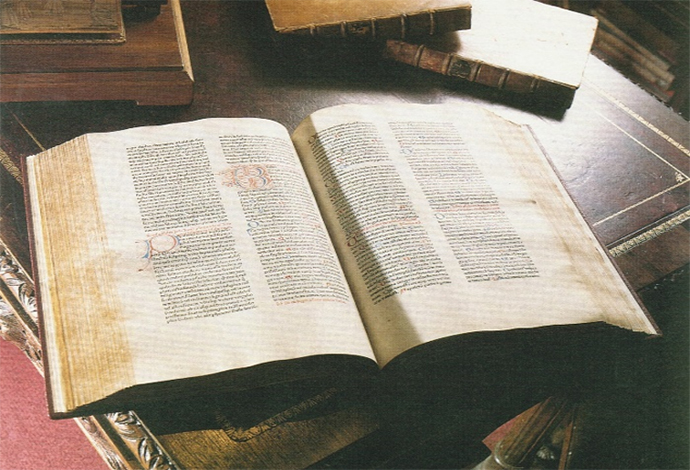
In the mid-1990s we sold the John Gartner copy of the Schoeffer Bible, printed in Mainz, in February, 1472—less than twenty years after the famous 42-line Bible of Johann Gutenberg. This copy now resides in the Baillieu Library, The University of Melbourne.
Peter Schoeffer was a Paris-educated scribe and master calligrapher who became Johann Gutenberg’s apprentice. He ‘greatly assisted’ Gutenberg in the invention of printing , and worked with him on the landmark 1455 Gutenberg Bible.
The Bible is a library in itself, being composed of many separate books by separate writers, covering a religious history of the world. Apart from very early editions, famous because of their printers, the majority of Bibles have little commercial value, although some of those produced by 19th and 20th century private presses, for example, also have considerable importance. Many of the Bibles most keenly sought by collectors are notable because of various misprints and the eccentricities of translators and artists. A list of some of these makes fascinating reading. They include
The POOR MAN’S BIBLE: printed in Basle, 1491: the first small format (i.e. octavo) Bible, hence the name.
The BUGGE Bible, 1535: the first Bible printed in English. Coverdale’s translation rendered Psalm 91, Verse 5 Thou shalt not need to be afrayde for anye bugges by nyghte, substituting ‘Afraid of bugs by night’ for ‘Terror by night’.
The TREACLE Bible, 1535: as above, with Coverdale’s translation rendering Jeremiah VIII, 22 Is there no tryacle in Gilead, substituting ‘Treacle’ for ‘Balm’.
The WIFE-BEATER’S Bible, 1549: Day & Sere’s edition of the Matthew Bible rendered Peter III, 2, and yf she be not obedient and helpful unto hym, endeavoureth to beate the feare of God into her heade.
The BREECHES or Puritan Bible: 1560: One of several editions produced by the Protestant exiles at Geneva during the last year of Queen Mary’s reign. Genesis III, 7 reads And they sewed fig tree leaves together, and made themselves breeches rather than ‘aprons’.
The WICKED Bible, 1631: The hapless printer left one word out of the seventh commandment, rendering it Thou shalt commit adultery.
The UNRIGHTEOUS Bible, 1653: Field’s 24mo edition of the King James’ Bible renders Corinthians VI, 9 Know ye not that the unrighteous shall inherit the kingdom of God.
CROMWELL'S ‘SOLDIER'S BIBLE’, 1643: Issued to boost morale amongst Cromwell's soldiers, this Bible consisted of appropriate quotations of the scriptures in pocket form, and was generally buttoned between the coat and the waistcoat, next to the heart, "proving sometimes a defence from the weapons of the enemies of their bodies, as well as the wicked one who sought to subdue their souls".
The VINEGAR Bible, 1716-1717: John Baskett’s folio edition of the King James’ Bible misprints one of the page captions as The Parable of the Vinegar instead of ‘The Parable of the Vineyards’. This edition, produced in a costly and sumptuous style by John Baskett, had so many mistakes that it became known as a BASKETTFULL OF ERRORS.
The MURDERERS’ Bible, 1801. An Oxford University Press octavo of the King James’ Bible which misprints Murderers for ‘Murmurers’ in Jude 16.