Marginal Notes 51: Sharing the knowledge

During this year’s Melbourne Rare Book Week (MRBW), ANZAAB presented an event entitled Why It Matters: Collecting rare books and manuscripts in a digital world. The topic was particularly relevant following media reports of companies purchasing large scale quantities of secondhand books, with the aim of training their artificial intelligence models—with the physical books being disbound to convert the text into digital form and then pulped as waste paper.
The ANZAAB event was well attended and well received, with the panel of experts discussing the pros and cons of converting rare texts to digital form. Unsurprisingly, the audience and panel concluded that physical books do matter!
Various aspects of the panel’s debate reminded me of my introduction to a Book Trade Symposium held during the 35th ILAB Congress in Edinburgh in the year 2000. My introduction was based on the importance of one word, and its application. The word was ‘knowledge’ – variously defined as the understanding, awareness, or information that you obtain through study or experience.
The word has frequent use in quotations and mottoes. Mottoes are chosen because they reflect the interests, beliefs or ideals of those who adopt them. Surprisingly, the majority of mottoes I found incorporating the word ‘knowledge’ have been used by the Royal Air Force, mainly for their training schools. These include:
• Knowledge dispels fear
• Knowledge fortifies the empire and
• Knowledge sustains.
In a similar vein, the RAF has also adopted the mottoes
• Learn and lead
and
• We learn by teaching.
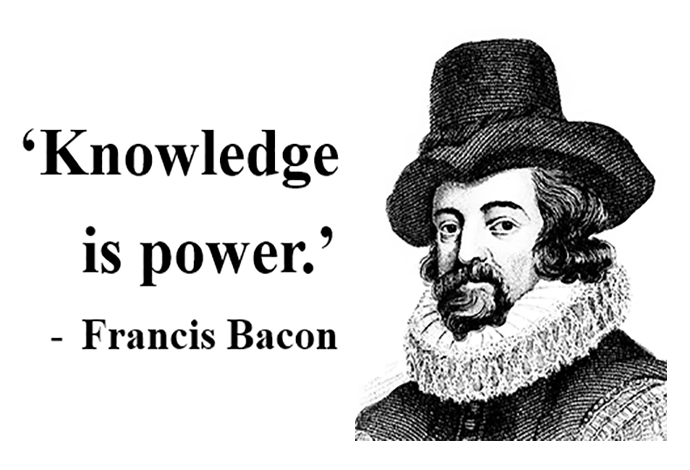
The phrase ‘Knowledge is power’ - first used by Francis Bacon in the sixteenth century - became the catchphrase of the printing industry during the twentieth century.
However, I believe the basis for my fascination with the word ‘knowledge’ is to be found in the motto adopted in the 1930s by the Printing Industry Craftsmen of Australia. It is:
• Share your knowledge.
It can be difficult for secondhand and antiquarian booksellers to learn about their trade in a scholarly way. If you are relatively new to bookselling you may need courage to publicly admit the gaps in your expertise. Paradoxically, the ability to openly say ‘I don't know’ comes through years of experience.
The term ‘expert’ has been defined as ‘one who knows more and more about less and less’. It is a wise bookseller who realises that the more you know the more you need to know. I wonder how many booksellers would join me in admitting that, when asked to address an audience of book collectors, they would prefer the role of pupil or observer to that of lecturer.
I believe that events such as this year’s ANZAAB’s MRBW event, and ILAB’s Book Trade Symposia, invigorate and substantiate our place in the world of books - both real and virtual. They encourage the interchange of roles, and allow the expert to both teach and be taught. They foster a generosity of spirit, along with healthy competitiveness. They provide the opportunity to benefit from the collective knowledge of the world's best booksellers, and to interact with the wide world of scholars, librarians, and book collectors who are supportive of our aims and ideals.
In the year 2000, we were only just becoming used to the world wide web and its promise of instant information. It was often said that the digital revolution was thought of as ‘global village heaven’ by some and as ‘futuristic hell’ by others. In today’s world we have the all-encompassing and often invasive influence of the Internet, but the fundamental principle that information without application is useless still applies. Accredited booksellers have a role to fulfil in not only providing informed opinion and information but also by demonstrating the integrity of their sources of information.
We need to remember that the knowledge made available at the push of some keys emanates not from robotic machines but from human beings—people like us—who need to continually learn from their own and others experience, so that they can ‘share their knowledge’.