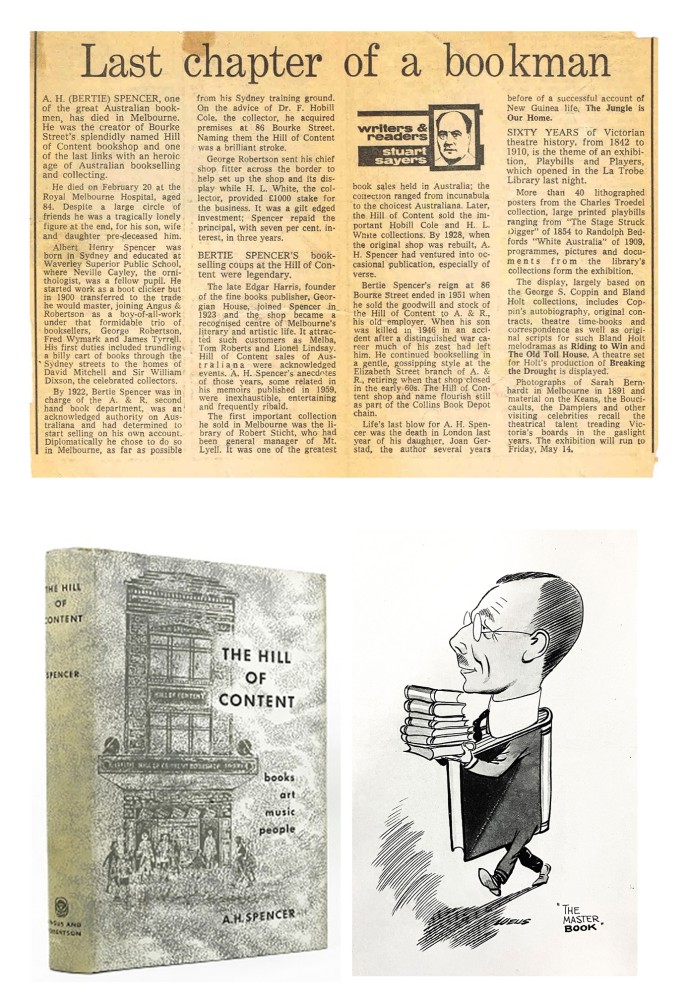
Marginal Notes 26: Writers and Readers: A. H. Spencer [1886-1971]
![Marginal Notes 26: Writers and Readers: A. H. Spencer [1886-1971]](https://kaycraddock.cdn.bibliopolis.com/images/upload/event_press_36_1.jpg?auto=webp&v=1726536294)
Writers and Readers: Last chapter of a bookman [Stuart Sayers The Melbourne Age, 1971]. A. H. Spencer [1886-1971]
It is one of my regrets that I was not able to visit A. H. Spencer’s Hill of Content bookstore during his reign at 86 Bourke Street, Melbourne. Although the bookstore continues to this day under that name, Spencer sold the goodwill and stock in 1951.
Many have written about this legendary bookseller, but I will quote from Stuart Kell’s Rare. A life among antiquarian books [Folio, Sydney, 2011].
‘With rare Australiana his main speciality, A. H. ‘Bert’ Spencer was Melbourne’s main rare bookseller of the 1920s and 30s. He established the celebrated Hill of Content bookshop in Collins Street and, in the mid-twenties, dispersed the great library of Dr F. Hobill Cole.
Spencer’s memoir of the Hill of Content is a delectable portrait of Melbourne’s antiquarian book scene in the first half of the twentieth century. Who could forget his tale of becoming wedged in the narrow tin bath out the back of the Hill – until his staff rigged a block and tackle and ‘persuaded’ him out. Spencer trained in Sydney under Fred Wymark at Angus & Robertson. Wymark could sense an Australian rarity ‘anywhere between Peru and Kamchatka and knew its history, its value and its probable purchaser’. Spencer cultivated the same nose for ferreting desirable books. Frank Morton [in Spencer, Hill of Content] wrote of Spencer’s style of bookselling:
He saunters about Australia, and buys the libraries of those who have been unable to take their books away with them (to Heaven or the other place). Then he writes cunning words in the books and sells them over again to us and the other fellows. There is little he doesn’t know about books. As to selling books – listen here! Mr Spencer is never at a loss. If it isn’t a first edition, he will make you believe it is somehow better. A little while ago he got an old dog-eared copy of the Bible printed in New York, or Grand Rapids, or Ossewooskee, or one of those American towns, and the curious format filled him with hope. He wrote on the fly-leaf: ‘Second (and best) American Edition of this Most Interesting Work – 42s.’
Considered a rogue by some, Spencer was more honest and competent than Morton implies. He once bought a box lot in a Sydney auction. It contained a rare pamphlet which he took to Sir William Dixson, making the mistake of telling his customer what the lot cost. The knight replied, ‘Very well, skinflint, it cost you half a crown; of how much will you rob me for this miserable pamphlet?’ ‘Fifty pounds’.
‘What! You damnable robber! Spencer, Fred Wymark taught you too well, Lord forgive him, and you,’ came from Sir William. Growling ferociously, he opened a drawer, took out his cheque-book, banged it down on the desk, wrote a cheque for fifty pounds, walked over to me and dropped it in my pocket. Then! Then it was his turn for the happy hearty ‘wide’ laugh for, holding the pamphlet in an attitude as though daring me to rob him of it, he almost danced with glee as he said, ‘Spencer, you fathead, I’d have paid one hundred pounds for this!’