Marginal Notes 25: FAQ Why our book slips?

Our practice of placing a paper slip showing full collation details within each of our books had its genesis in two early experiences in our bookselling journey.
The first was when I, as a teenager, bought a book of Adam Lindsay Gordon’s poems from a secondhand bookshop in Windsor. From memory I was sixteen at the time, and the 10 shillings I paid for the book was a major purchase for me. I was later extremely disappointed to discover that the book lacked a whole section of text, and was therefore, so to speak, a write-off.
The second experience, also in the early 1960s, was when my mother, Muriel Craddock, bought some books from an auction held by Kirk’s Bazaar in Essendon. These comprised numerous books on the goldfields, a book on nineteenth century sheep husbandry and other Australian subjects. Muriel decided to offer them to a Melbourne antiquarian bookseller, who on examining the sheep book found that the pictorial initials at the start of each chapter had been excised. Muriel was mortified, particularly when the dealer was extremely rude to her because she had not checked the books for completeness before offering them to him.
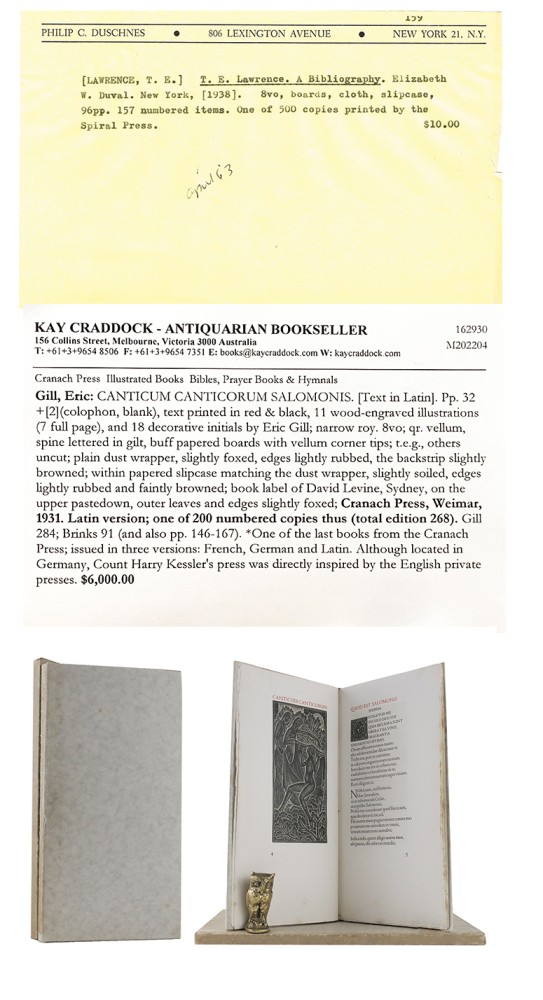
A decade later another two experiences convinced us as booksellers that we should not only collate all our books, but we should also declare any defects or negative aspects of the item on a book slip. The first was seeing the paper slips in the books we had bought by catalogue from Philip Duschnes of Lexington Avenue, New York, and the second was when I visited the premises of Francis Edwards Ltd during my first buying trip to London. I recall being impressed that they also had a paper slip in each book detailing collation and price. As a consequence we began to issue our own book slips, which are now a hallmark of our business.
It was also our experience that books we ordered from the book trade were often in poorer condition than described. It became our aim that when interstate and overseas customers ordered from us, the books they received often turned out to be better than our description implied. On one occasion, when we issued a catalogue devoted to private press books, a colleague expressed his surprise at our catalogue entry for the rare special issue of The Golden Cockerel Press Napoleon’s Memoirs (bound in gilt-decorated purple and green morocco), in which we made no comment about the book’s particularly fine condition. I replied that qualification was unnecessary as we listed no defects in the entry, to which the bookseller responded, ‘How very Maggsian’.