Marginal Notes 22: Our first catalogues

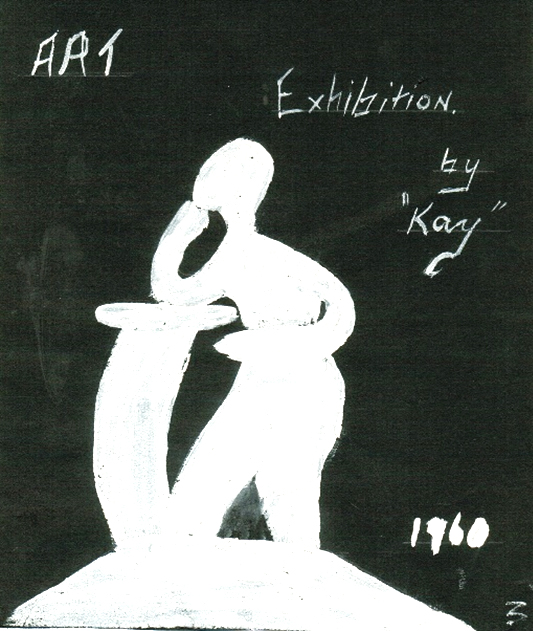
My first forays into the joy of cataloguing were, in retrospect, rather precocious. My early ambitions included becoming a writer, an artist, or a librarian. At the age of fifteen, I held two exhibitions of my high school art in my bedroom at home. For the first I prepared a hand-written four page catalogue and poem, within illustrated wrappers. A hand-written poster of rhyming couplets calling for donations accompanied this, together with a notice: Vote for the painting you like best in each section. 1d. a vote. Then vote for the 3 best exhibits of all. 3d for the 3 votes. Collect Ballot forms from table. [I obviously did not understand the appeal of a discount for quantity]. The second exhibition catalogue featured a typed poem, which was a guide to the exhibits. Neither of these attempts to be commercially successful as an artist worked.
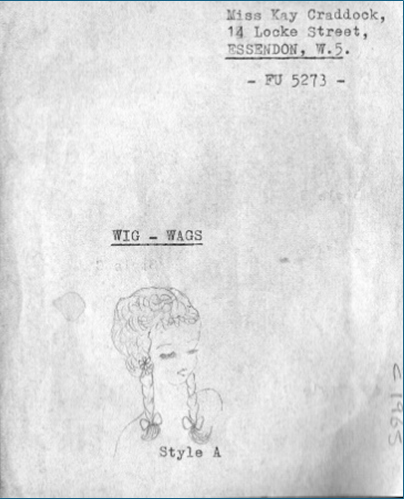
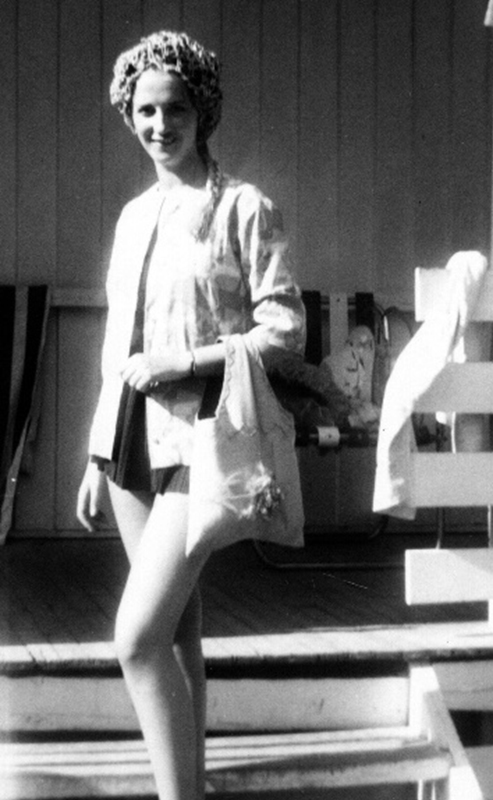
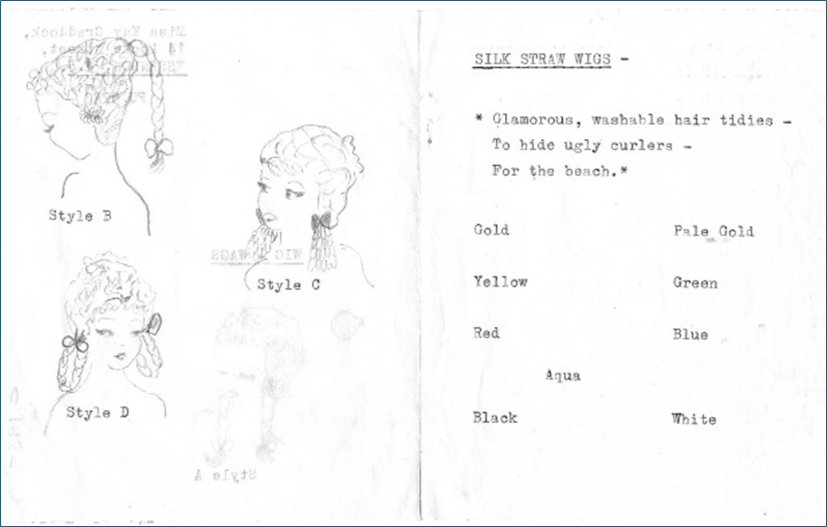
My next experience of small business, this time with my parents, was successful. My mother and I shared a love of handicrafts, particularly crochet, with several of Muriel’s designs for doilies published in the Semco pattern books. In those post-rag curl and pre-hair dryer days of the early 1960s, girls enhanced their hairstyles by using curlers, which had to be left in until the hair was dry. Muriel designed a crocheted silk straw snood, decorated with various styles of plaits at the side or back, to cover the curlers. We called them Wig-wags and I made a small format single-fold advertising leaflet, hand illustrating the four styles (available in nine colours), with a typed text for these Glamorous, washable hair tidies – To hide ugly curlers - For the beach. My father helped me to compose an accompanying letter, which we sent under my name to Binnie Lunn, a local radio personality who was also a buyer for the Melbourne department store, Buckley & Nunn. This was, in effect, our first commercial catalogue and it was a sell-out. Miss Lunn ordered six of each style in a variety of colours. The seeds for self-employment were sown. [I obviously also chose to demonstrate the wig-wags by actually wearing one during a holiday on Hayman Island in the 1960s!].
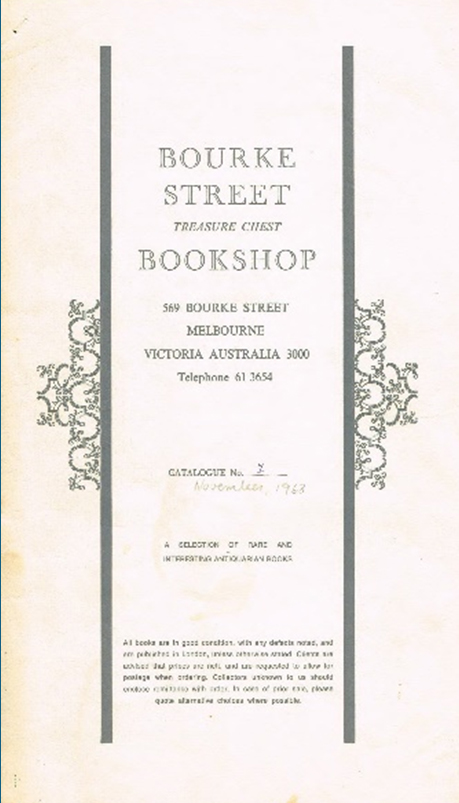
In 1969 we issued our first catalogue. I had been doing some part-time work for Paul Dwyer at Joel’s auction house. Paul had asked me to help catalogue a collection of books and paintings for sale. My role was to type up cards with the catalogue entries. At this time my mother and I felt we should issue our own catalogue. I typed the master version of the catalogues on waxed Gestetner sheets. Corrections were made with a pink liquid. This first catalogue was produced on Joel’s Roneo duplicating machine, after which we bought our own duplicator. The following is an extract from Rare. A life among antiquarian books by Stuart Kells. Folio, Sydney, 2011
Publishing a catalogue demands a cataloguing policy. Kay rather than Muriel was the prime mover here. Cataloguing is not as straightforward as it seems. The controversies about catalogue standards and descriptions are legion. Writing in 1952, John Carter stressed the differences between booksellers’ descriptions, and the complete absence of science: ‘collectors should be warned that the seemingly objective sequence from “mint” (good) to “good” (bad), which has crept into the lower end of the book market from philately, is as much a matter of personal opinion’.
In a decision that would define the firm’s character as booksellers, Kay eschewed the problematic bookselling descriptions of ‘fine’, ‘very good’, ‘good’ and so forth. The firm had already chosen to stock books in the best available condition. This provided the foundation for Kay’s decision to state the whole truth about any faults, erring on the side of over-stating them in order to build trust and a strong reputation for ethical cataloguing. And if a book had no defects then nought needed to be said about its condition.