Marginal Notes 23: FAQ Owls

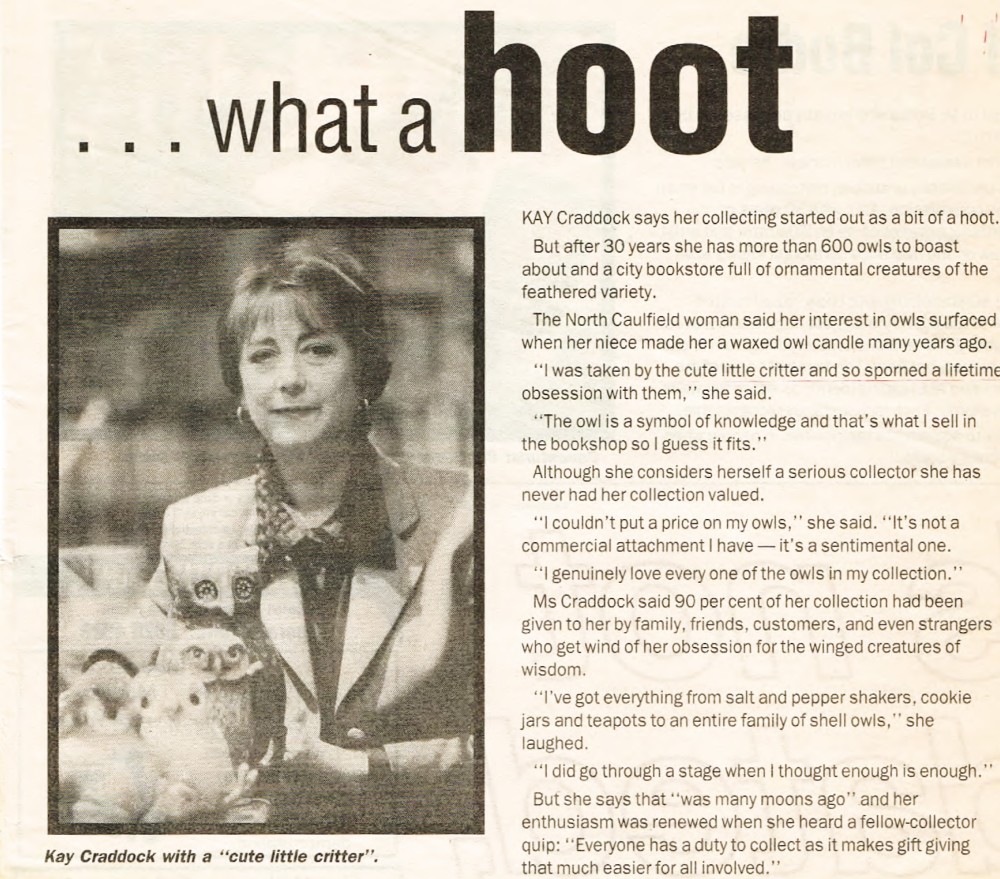
A permanent collection of owls is scattered throughout our bookshop. The first of these, two small wax candles in the shape of an owl, were made for me by my very young nieces, Marilla and Kylie, in the 1970s. Such was my enthusiasm that they continued to give me an owl for birthdays and Christmas for many years. In the 1980s when we moved our bookshop to Cavendish House we couldn’t put books on display in our easterly facing windows because of the heat of the sun, so we started to display the owls. This led to customers donating owls to the collection, and their number is now in the thousands, and the collection has become a draw-card for visitors.
We have a policy that we neither buy nor sell the owls—nor do we ask for them! The rationale is simple: if we bought all the owls people offered us we would be expending a lot of money; if we sold the owls the whole collection would have disappeared from our premises decades ago.
There are many stories attached to the way in which the owls have been given to the business. Amongst these stories is that of a young Japanese couple who came in wanting to sell us a lovely wood-carved owl from their country. After hearing our policy they politely bowed to me and left the shop, only to return an hour later. The young man handed the box containing the owl to me, saying ‘We realise the importance of the owls in your shop and how non-commercial they are, and we would like you to have this as a gift.’
Similarly, there is the story of young George and his parents. They arrived in the bookshop one morning carrying a large bamboo bag full of owls, which they wanted to sell. We explained our policy of neither buying or selling the owls, which they accepted with good grace. Later that morning they returned to the shop, saying that George wanted their owls to ‘live’ with all our owls. As a tribute we devoted a whole window to his owls, which pleased the small boy immensely.
Another window display of owls, this time for our 1993 book launch of Australian Owls, Frogmouths & Nightjars, by Jill Morris and Lynne Tracey, led to perhaps the most poignant story of all. The display had been seen through the window of a bus by a young girl named Ellen who suffered spina bifida. Captivated by the owls, Ellen used her own money to buy an owl from a school fete which she gave to her carer to bring in to us. When I asked her carer what I could send Ellen as a thank you he replied that there was nothing. Ellen died in 1997, aged 12. I was deeply moved by the realisation that somebody who was handicapped all of her short life could make such a gift to me, who is enjoying a long and very good life. It gave our owl collection a reason for being.